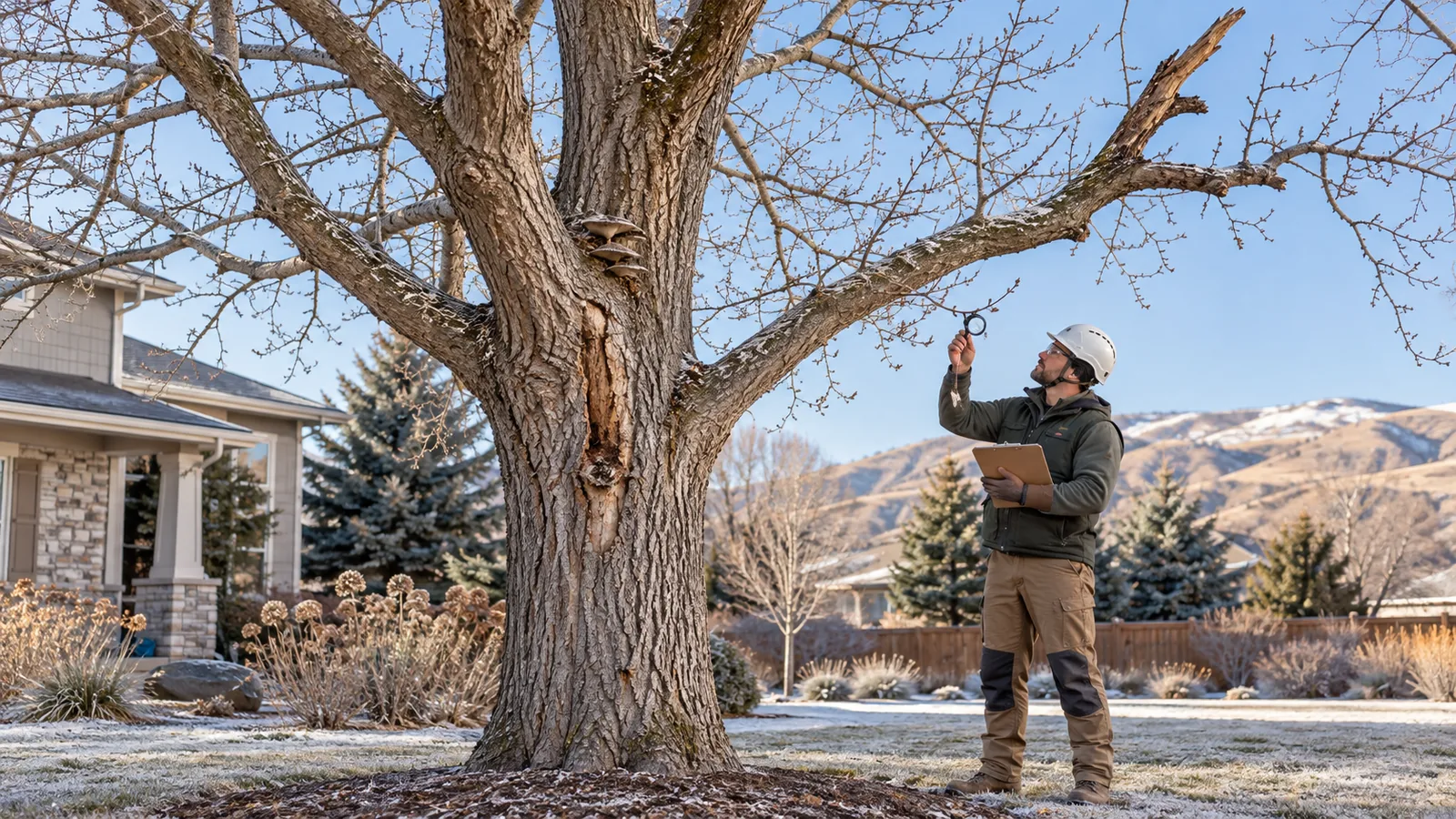
Every fall, a perfectly healthy deciduous tree drops its leaves and goes dormant for winter — and every fall, we get calls from homeowners worried they suddenly have a dead tree. Telling the difference matters, because removing a living tree is a loss you cannot undo, and leaving a truly dead one up is a real safety risk.
Dormant: what it looks like
Dormancy is a tree's normal winter survival strategy. A dormant deciduous tree will typically show:
- Leafless branches that are still flexible, not brittle.
- A thin layer of green tissue visible just under the bark if you gently scratch a small twig (the scratch test).
- Small buds already formed along the branches, ready to open in spring.
- Firm, intact bark with no large areas peeling away.
Evergreens are a separate case — a healthy pine or spruce keeps its needles year-round, so widespread needle drop or browning is a different signal worth investigating rather than dismissing as normal dormancy.
Dead or declining: what to look for
- The scratch test fails: no green layer under the bark on multiple branches, just dry, brown tissue.
- Brittle branches: small branches that snap cleanly and feel dry all the way through, rather than bending.
- No buds by late winter: as other similar trees nearby begin forming buds, a dead one shows none.
- Bark falling away: large sections of bark sloughing off, exposing dry wood underneath.
- Fungal conks or mushrooms: shelf-like fungus on the trunk or at the base often signals internal decay.
- A hollow-sounding trunk: tapping the trunk and hearing a hollow sound in multiple spots can indicate significant internal rot.
The scratch test, step by step
On a small branch (not a major trunk or limb), use a fingernail or small knife to gently scratch away a sliver of the outer bark. Living tissue (cambium) underneath is typically green or pale and slightly moist. Dead tissue is dry, brown, and brittle. Check two or three spots on different branches, since one dead twig does not mean the whole tree is gone — but if every branch you check is dry and brown, that is a strong signal.
Why a dead tree should not just be left standing
Unlike a declining lawn or a struggling shrub, a dead tree is a structural hazard that only gets worse with time. Dead wood becomes more brittle each season, and a dead tree's root system stops contributing to its own stability the way a living tree's does. Add Boise's winter snow loads and wind events, and a dead tree near a house, driveway, fence or walkway is a matter of when, not if, something comes down.
What to do if you are not sure
When a tree shows some mixed signals — dormant-looking in most places but with a few concerning spots — it is worth getting an actual look rather than guessing. A tree health assessment can determine whether a tree is dormant, partially declining, or truly dead, and whether pruning out dead sections is enough or the whole tree needs to come down. If the tree is confirmed dead and poses a risk, see our tree removal page, and if it is already failing or storm-damaged, that becomes an emergency tree removal situation instead.
Spring is often the moment of truth
If a tree you were unsure about still shows no leaves or new buds well after similar trees around it have leafed out in spring, that is usually the clearest confirmation that it did not survive.
Frequently asked questions
Can a tree be partly dead and partly alive?
Yes — a tree can have dead limbs or a dying section while the rest remains healthy. This often calls for targeted pruning rather than full removal.
Is a tree with fungus on it always dead?
Not always, but fungal growth, especially shelf-like conks on the trunk, is worth having evaluated since it often points to internal decay that is not visible from the outside.
How fast does a dead tree become dangerous?
It depends on the species, size, and local weather, but dead wood weakens progressively, so there is no safe amount of time to leave a confirmed dead tree standing near a structure or walkway.
Does winter make it harder to tell if a tree is dead?
It can, since the normal leafless look of dormancy resembles a dead tree at a glance. The scratch test and bud check work in any season and are more reliable than appearance alone.