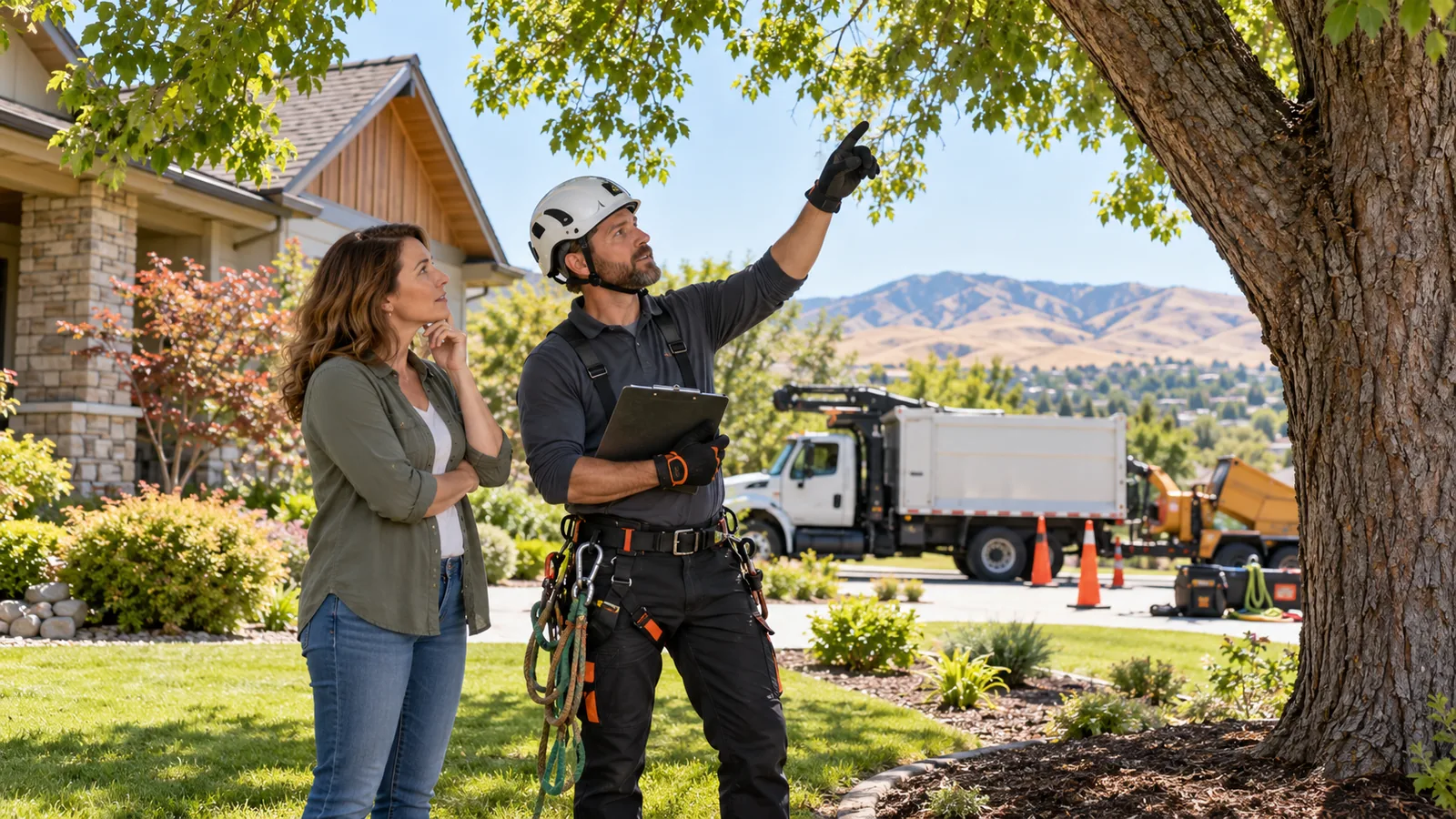
Boise has no shortage of people willing to take down a tree for cash. Not all of them are insured, trained, or planning to still answer the phone if something goes wrong. Asking the right questions before you hire protects your property, your neighbors' property, and the crew doing the climbing.
Why this matters more in Boise than it might seem
Many Boise yards have mature trees close to roofs, fences, driveways and overhead lines, and a lot of properties back up to foothill terrain with uneven ground. A rushed or underinsured job here does not just risk the tree — it risks the house next to it. Taking a few minutes to vet a company before they start climbing is cheap insurance.
10 questions to ask before you hire
1. Can you show proof of insurance?
Ask to see it, not just hear about it. General liability covers property damage; workers' compensation covers an injury on your property. A company that cannot produce either on request is a risk you would be taking on yourself.
2. Who will actually be on site?
Some companies sell the job, then subcontract the climbing to a crew you never meet. That is not automatically a problem, but you deserve to know who is working in your yard and who to call if a question comes up mid-job.
3. What exactly is included in the price?
Removal alone is a different job than removal plus stump grinding plus full debris haul-away. Get each piece spelled out so you are comparing the same scope across estimates, not just the smallest number.
4. How do you handle work near power lines?
A tree touching or near a line needs a different approach, and sometimes coordination with the utility company, before any cutting starts. A company that brushes past this question without a real answer is a red flag.
5. Do you have the right equipment for my property?
A tight side yard, a steep slope, or a tree over a fence line can rule out certain equipment. Ask how they plan to access the tree — a vague answer here often means a vague plan on the day.
6. What happens to the wood and debris?
Some companies haul everything away, some leave rounds for firewood on request, and some charge extra for full cleanup. None of these is wrong, but you want to know before the truck leaves.
7. Can I get a written, itemized estimate?
A verbal number is easy to change later. A written estimate that lists the scope, price and what is excluded protects both sides if there is ever a disagreement about what was agreed to.
8. How will you protect my lawn, driveway and neighbors' property?
Plywood under equipment, careful rigging near fences, and a plan for where branches will drop all matter more on a tight residential lot than on open land. Ask directly — the answer tells you how much they have thought about your specific yard.
9. What is the plan if the weather or job changes mid-way?
Wind, an unexpected rotten section inside the trunk, or ice can change a job partway through. A company with a real answer here has probably dealt with it before.
10. Can I see past work or talk to a reference?
Photos of completed jobs, a few customer names you can call, or reviews you can verify all tell you more than a sales pitch does.
Red flags worth walking away from
- Door-to-door offers right after a storm, pressuring you to decide the same day.
- Insisting on full payment in cash before any work begins.
- No business address, no insurance paperwork, or a phone number that is not answered as a business.
- A bid dramatically lower than every other estimate with no explanation for the gap.
- Refusing to put the scope of work in writing.
What a trustworthy estimate looks like
At minimum, expect it to state: the exact work being done, what is included and excluded, an approximate timeline, and the company's contact information. If stump grinding, debris removal or cleanup are optional add-ons, they should be priced separately and clearly, not buried in a single lump number.
Frequently asked questions
Should I get more than one estimate?
It is a reasonable step for any job beyond a small, routine trim, especially for removals or work near structures.
Is the cheapest estimate always the best choice?
Not necessarily. A bid far below others can mean missing insurance, no cleanup included, or inexperience with a tricky removal.
Do I need to be home for the estimate?
It helps. Being there lets you point out specific concerns and ask questions on the spot rather than over email.
How do I verify a company's insurance?
Ask for a certificate of insurance. If you want extra assurance on a large job, you can call the listed insurer to confirm the policy is active.