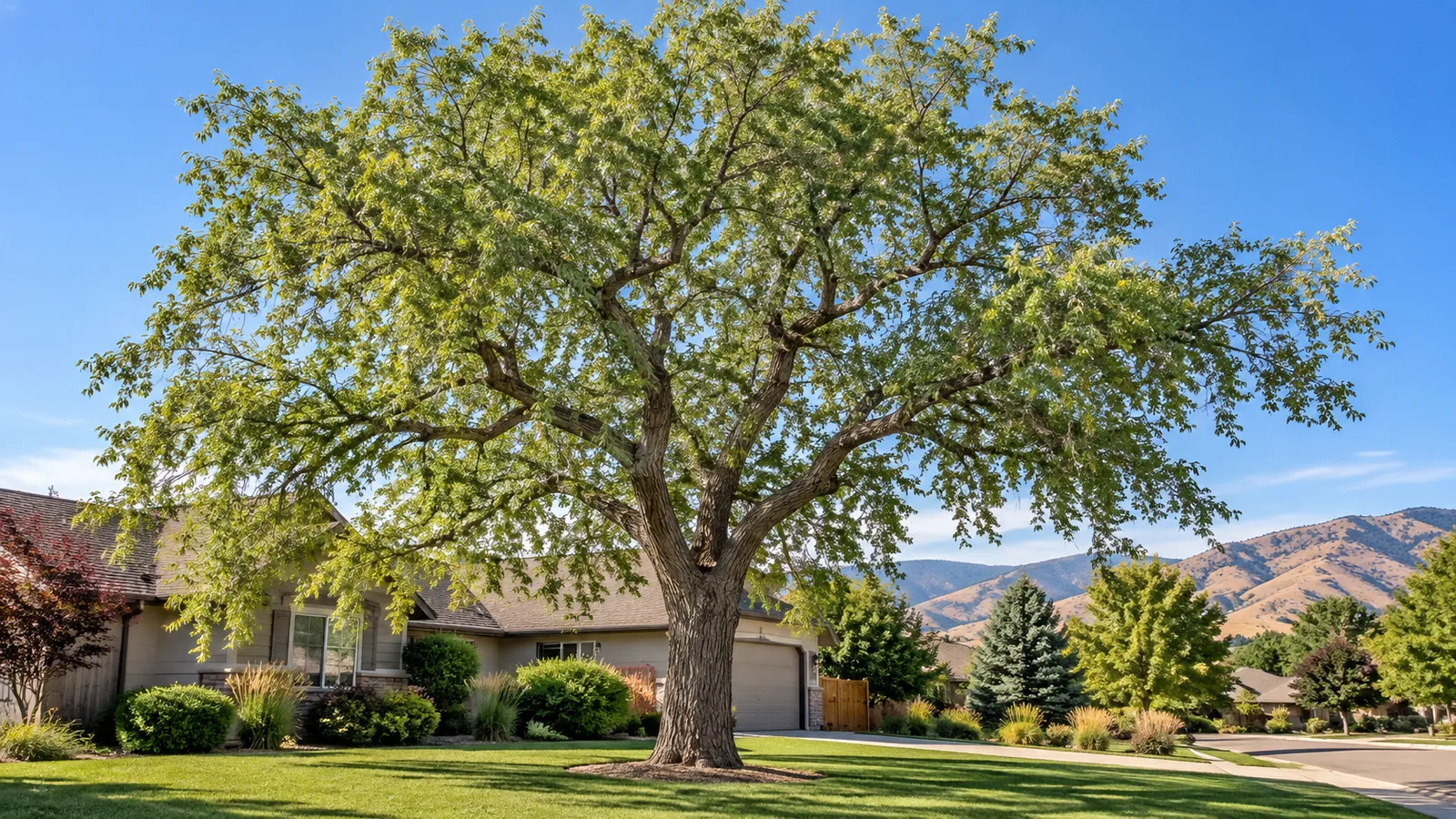
Siberian elms are among the most common trees in older Boise-area yards, and also among the most likely to drop limbs in wind, snow and ice. Not every one needs to come down. This guide explains why they fail, which warning signs matter and how to decide between pruning and removal.
Why Siberian elms are so common here
Siberian elm was widely planted across the dry western states because it grows fast and tolerates drought and cold. In Boise it now appears in yards, along fence lines and in vacant lots, and its many seeds sprout wherever they land. That is why you often find volunteer seedlings you never planted.
Why Siberian elms break
- Brittle wood: fast growth produces wood that snaps more easily than slower-growing trees.
- Weak forks: many grow with two or more main stems joined at a tight V, sometimes with bark trapped between them.
- Heavy canopies: a full crown catches summer wind and holds snow and ice in winter.
- Past topping or poor cuts: regrowth after topping attaches weakly and can fail.
Warning signs to look for
- Large dead branches or a thinning, dying crown.
- Cracks or splits at a fork, or bark pinched inside the V.
- Fungus on the trunk or roots, or hollow areas.
- Dark, wet-looking oozing from the trunk.
- A lean that is new or getting worse, or soil lifting near the base.
- Branches hanging over a roof, driveway, play area or power line.
If you see several of these, book a tree risk assessment. If a limb is already down or a tree is leaning after a storm, treat it as urgent and call for emergency tree removal.
Prune or remove?
Pruning may be enough when the tree is otherwise healthy and the problem is deadwood, crossing limbs or excess weight on one side. Careful tree pruning can reduce risk, though it does not make a weak-wooded species strong. Support such as cabling and bracing may be considered for selected forks.
Removal makes sense when the tree is dead or declining, has a serious structural defect or root problem, or is close enough to buildings or lines that a failure would cause real damage. The decision depends on both the tree's condition and what is underneath it.
What removal involves
The crew reviews access, structures and lines, then plans how to take the tree down in sections or with rigging when space is tight. Never attempt work near power lines yourself; call the utility about line-adjacent trees. Afterward, ask about stump grinding, because Siberian elms can send up sprouts from the stump and roots. Our tree removal page explains the process.
Replacing it
Pick a tree for your sun, soil, irrigation and available space rather than for speed of growth. Bur oak and Kentucky coffeetree are examples worth asking an arborist about for Boise conditions. Check with the City of Boise before removing or planting trees in the street right-of-way, since street trees are not always treated like trees in your own yard.
Frequently asked questions
Is a Siberian elm a bad tree?
It is a weak-wooded, high-maintenance tree, but a healthy, well-pruned one in a safe spot can be kept.
Can a damaged Siberian elm be saved?
Sometimes. Deadwood removal, weight reduction and support may work if enough sound structure remains. An on-site assessment is the way to know.
Why do I have so many elm seedlings?
The tree produces large amounts of seed each spring. Pulling seedlings while young is easier than cutting older saplings later.
Does removal cost more near a house?
Often yes, because rigging and careful lowering take more time than a straight fall. Ask for a written scope.